When you buy through links on our articles, Future and its syndication partners may earn a commission.

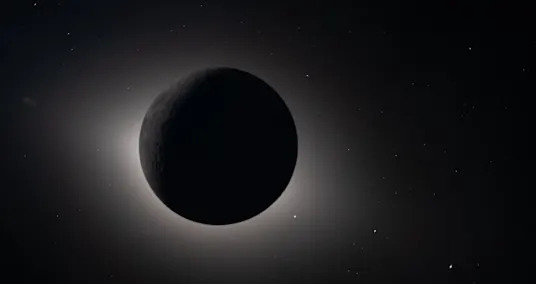
NASA's Artemis 2 astronauts have witnessed one of the rarest sights in spaceflight history — a total solar eclipse from beyond the moon.
The event unfolded yesterday (April 6) as the Orion spacecraft looped around the far side of the moon. This trajectory placed the crew in the right place at the right time to see the moon completely block the sun for about 53 minutes, which is far longer than the maximum period of totality for eclipses seen from Earth.
But it wasn't just the duration that made this eclipse extraordinary; it was the view.
NASA astronaut Victor Glover described the scene unfolding as the sun vanished behind the lunar disk.
"This continues to be unreal. The sun has gone behind the moon and the corona is still visible. It's bright and creates a halo almost around the entire moon," Glover said.
As darkness fell, another phenomenon quickly emerged. "When you get to the Earth side, the earthshine has already shown … almost seconds after the sun sets behind the moon, you can see earthshine," he added.
From Orion's windows, the crew was able to make out the faint glow of sunlight reflected off Earth, while stars and planets appeared in the background. The moon itself became a stark silhouette: "This black orb out in front of us," as Glover described it, edged by the glowing solar corona.

Though a rare sight, it's not the first time a solar eclipse has been viewed from lunar realms. The Apollo astronauts, who orbited the moon rather than flew by it (as Artemis 2 did), also saw solar eclipses, NASA's Kelsey Young, Artemis science flight operations lead, said during a press conference on Saturday (April 4).
The eclipse marks just one highlight in an already historic mission. Artemis 2 is the first crewed journey to the moon since Apollo 17 and has already set a new distance record for human spaceflight.
Following their impressive lunar flyby, the astronauts are now heading back toward Earth and are expected to splashdown on Friday (April 10) off the coast of San Diego.
LATEST POSTS
- 1
 Fundamental Home Machines: An Easy to understand Determination Guide
- 2Figure out How to Track the Establishment of New 5G Pinnacles
- 3Find the Keys to Fruitful Venture The board: Conveying Results on Time
- 4The Ascent of Robots: Occupations That Man-made brainpower Might Dispense with
- 5Israel says Iran's military industry will be destroyed 'within days'



- Only 30% of young people in Israel optimistic about future, Aluma survey reveals
- I tried a macho, creatine-loaded cereal “for men.” Did I mention I'm a woman?
- Alice Wong, founder of the Disability Visibility Project, dies at 51
- Geminid meteor shower, one of the year's most reliable, peaks this weekend
- How to see the Ursids, the final meteor shower of 2025
- AI is making spacecraft propulsion more efficient – and could even lead to nuclear-powered rockets
- Russia patents space station designed to generate artificial gravity
- At least 55 injured in Russia after train crashes, overturns
- Israeli archaeologists launch project to trace origins of ancient pottery