Protests took place in Tel Aviv, Jerusalem, Haifa, and Beersheba, as a survey found broad but uneven support among Jewish Israelis for Operation Roaring Lion.
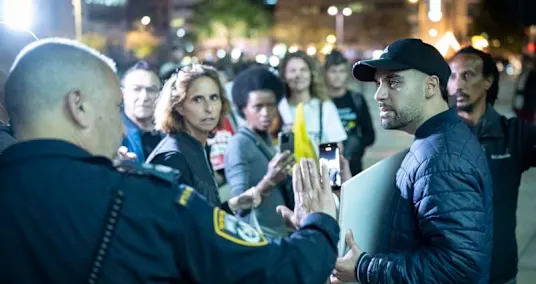
Israel Police arrested 21 anti-war protesters Saturday night as demonstrations against the conflict with Iran expanded in multiple cities despite restrictions on public gatherings.
Protests took place in Tel Aviv, Jerusalem, Haifa, and Beersheba, with hundreds of participants reported in Tel Aviv and Jerusalem and about 100 in Haifa, marking the largest turnout since weekly demonstrations began. Authorities said 13 people were arrested in Tel Aviv and eight in Haifa.
Police said the gatherings were not approved under Home Front Command regulations that ban events with more than 50 people. Officials said the increase in turnout followed calls by groups opposing the government to protest despite the restrictions.
“During a situation assessment that took place at the scene with a Home Front Command representative… it was clarified that there was a real risk to human life and accordingly, Yarkon [precinct] police commander Tzachi Sharabi ordered the gathering to be dispersed,” police said.
Hadash-Ta’al chairman Ayman Odeh, an Arab lawmaker involved in the protests, criticized the police response, calling officers fascists “in the service of the government” and saying they were afraid of “the heroic citizens who went out, despite everything, to make their voice heard.”

Survey shows broad, uneven support for war
The demonstrations come as a March 2026 survey by the Israel Democracy Institute found broad but uneven support among Jewish Israelis for Operation Roaring Lion. Support was strongest on the Right at 87% and about half on the Left.
The survey also found that Jewish and Arab respondents largely agreed that Iran’s resilience has been stronger than expected. Most Jewish respondents said Israeli society could sustain the campaign for up to one month, while 28% said as long as needed. Arab respondents were less optimistic about how long the public could endure the conflict.
A majority of Jewish respondents said Prime Minister Benjamin Netanyahu’s decision was driven by security considerations, while most Arab respondents viewed it as political.
LATEST POSTS
- 1
 Nearly 16,000 New York City nurses prepare to strike as contract talks stall
 - 2Zelensky warns of imminent massive Russian attack on Ukraine
- 3NASA's Artemis 2 moon launch seen from space | Space photo of the day for April 2, 2026
- 4Help Your Business with Master Web based Promoting Arrangements
- 5Lula’s former human rights minister formally accused of sexual misconduct





- Volkswagen in talks with defence firms on use of Germany plant: CEO
- ‘Grit’ and relentless perseverance can take a toll on brain health − particularly for people facing social stresses like racism
- Bird flu poses risk of pandemic worse than COVID, France's Institut Pasteur says
- Most loved Road Food: Which One Prevails upon You?
- Nations for Youngsters to Visit
- The next frontier in space is closer than you think – welcome to the world of very low Earth orbit satellites
- Cathay Pacific raises fuel surcharge on all flights by 34%
- Nestlé says 413,793 KitKat candy bars stolen en route from Italy to Poland
- Merz says army could be involved in mine-clearing from Hormuz